
Posted on Wed, Dec 01, 2010 @ 02:19 PM
This article by Jim Garrity originally appeared in the November 2010 issue of ABA Bank Marketing.
Over the past few years many companies have embraced Net Promoter Score® (NPS) as a key loyalty metric. But NPS can do more than just tell you how likely your customers are to recommend your bank to others. With information obtained from the NPS calculation, marketers can figure out how to boost future loyalty—and thus improve bank profitability.
I’ll explain how. But first, let’s review the basics about NPS.
While people have been using “likelihood to recommend” as a key metric for years, the concept of “NPS” was introduced in 2003 by author and business consultant Fred Reichheld. Reichheld found through his research that asking a single question on a 0 to 10 rating scale: "How likely are you to recommend our company to a friend or colleague?" builds on a long-held truth that likelihood to advocate (recommend) is a strong indicator of loyalty and provides business users with a simple metric to benchmark against both internally and externally. (Net Promoter, NPS and Net Promoter Score are trademarks of Satmetrix Systems Inc., Bain & Co. Inc., and Fred Reichheld.)
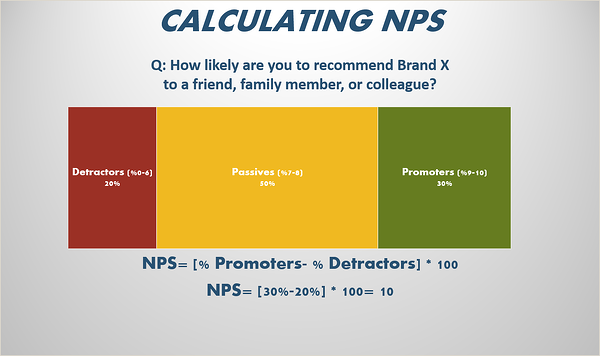
Just as net worth represents the difference between financial assets and liabilities, Net Promoter quantifies the difference between happy customers (Promoters) and unsatisfied customers (Detractors). By asking customers their likelihood to recommend your bank, you can sort your customers into three categories:
--Promoters (9-10 rating) They are loyal and enthusiastic. They adore you and actively recommend you.
--Passives (7-8 rating) They are satisfied, but unenthusiastic. They are neutral.
--Detractors (0-6 rating) They are unhappy customers. Often they are frustrated and specifically do not recommend you to others.
Building a NPS-style program for your bank
Building a NPS-style program focused on “whether or not people are likely to recommend your bank and why” provides management with a simple way to keep tabs on where they stand. With the right reporting system in place, such a program enables managers to take immediate action to fix problems and praise great customer service.
One of the benefits of a NPS-based measurement program is that it is useful across the entire organization so that everyone can be working towards interconnected goals and measure progress uniformly. This empowers management at three key levels:
At the executive level. Overall NPS scores (and other key metrics) can be tied to manager compensation and provide an easy way for divisions to be compared on the things that matter most to the company (customer loyalty). The open-ended responses also help bring the “voice of the customer” to the board room so that senior management is more connected to the customer facing employees.
At the management level. Management can use this type of program to evaluate strong and weak locations and channels (in-person, online, CSR) and identify best practices and problem areas to be explored further.
At the branch level. Managers have access to real-time data about the experiences of customers coming into their branches. The NPS scores help paint a clear picture of how their specific branch is performing and the open-ended responses identify employees and processes that are over –and underperforming.
It is important to prioritize improvement initiatives that are triggered by customer-experience research to focus on achieving these predefined goals and improve upon experiences specifically related to the brand, service delivery and products.
2. Short isn’t always sweet: Add elements to provide a broader view of loyalty. The foundation of Reichheld’s belief is that most research is too long/ complex and all you need is just one question. Nevertheless, I would argue that while short can be sweet, it can also be useless if you don’t obtain the information to -focus your improvement efforts. For example, adding a few additional questions so that you can follow up on learnings from previous waves of your program will enable to you to see if your customers are happy with the changes you have implemented and gauge your success in reaching your goals. In essence, you are creating a Customer Engagement Index (of which loyalty is key, but not the sole component) which you can track over time. In my experience, I have found that by adding a few key outcome measures you can elevate the score from a “rear view” look to a true Customer Engagement Index that allows executives and managers to quickly gauge changes in engagement (from general complacency to mere satisfaction to true advocacy) and decide when intervention is necessary.
3. Focus on the specific operational improvements that will have the greatest impact on loyalty behaviors. Sometimes it’s hard to prioritize which changes to focus on first. Using key driver analysis helps to take the guesswork out and enables banks to understand which changes will have the greatest impact on loyalty. To truly understand the impact of various experiences, using sophisticated analytics such as regression analysis/TreeNet, Decision Trees and Latent Class modeling can help you get at the underlying drivers of perception and behavior.
For example, a typical customer experience feedback system might show that there is greater dissatisfaction with ATM functionality than with online banking. This would indicate that considerable attention (i.e. human and economic resources) should be focused on improving ATM functionality and that improving ATM functionality would result in higher customer loyalty. However, a key driver analysis would show that ATM functionality is not a critical driver of loyalty and that online banking is. As such, focusing efforts on an area that is already performing better (i.e. online banking) would have a greater impact on customer loyalty than focusing on a less important (albeit lower performing) area.
In addition, using a Topical Module (asking a few other questions on another topic) within your NPS program can expand its usefulness dramatically. Adding an additional three to four minutes to probe deeper on a particular topic requiring attention can give you information you can use to make truly actionable improvements. For example, let’s say that your phone CSR scores have taken a dip (based on either the previous wave or recent internal/anecdotal feedback), you can use this module of questions to get greater depth of coverage on specific problem areas within your CSR operations, and with a probing question or two on this issue you can provide management with the necessary insights to drive action and direction. These rotating topical modules can also be used for one-time issues such as problem analysis, product/service concepts testing and message refinement.
To be successful, feedback programs must get actionable data into the hands of those who need it in a timely manner. There are many reporting tools out there that provide a highly intuitive yet powerful solution you can tailor specifically to the strategic customer experience goals identified at the beginning of your program and that can directly connect to your internal systems. This enables banks to quickly respond to customer feedback, track performance, analyze trends and identify effective action steps. Incorporating a robust reporting tool helps to drive proactive referral and sales lead programs to leverage promoters, as well as operational improvements to manage the business. Gathering the data is only part of the process, getting the data to the right people in a format they can easily understand is critical to driving customer loyalty.
That’s why many companies using the NPS concept have embraced the powerful reporting tools (business tools, not market research tools) that integrate with internal CRM systems to get the most out of NPS measurement programs and manage the access and distribution of both quantitative and qualitative data. For example, imagine that a customer remarked in the research that she “tried to find a parking spot, but there never seems to be enough parking at the Washington Street branch,” this comment can then be fed to senior management to see if this is a common customer complaint and look at how big of an issue parking is for their branch. Even more importantly, that customer feedback can also be sent to the branch manager within 24 hours allowing the manager to take action immediately. The branch manager can then make contact with the customer letting her know hercomplaint has been heard and what the branch is doing to address herconcerns. Imagine the customers’ response when the manager calls to thank her for the feedback and let her know the bank is putting in extra signage to designate “bank only” parking and they now have new shared parking with other businesses in the area. Again, this illustrates that the real value of a NPS program is not the data itself, but the actions you take based on the results.
Even with a steady flow of information into your organization, to increase Promoters it is important to review the program every six to twelve months to both gauge success and refine the goals. Equally important is getting feedback from your key stakeholders about their perceptions of the quality and usefulness of information and keeping them engaged in the process. This helps focus the company on the customer experience and reminds everyone that management is paying attention to the results.
NPS is not designed to replace a robust examination of all of your customer-facing touch points. In fact, one of the key roles of a NPS program is to identify problem areas that need further examination through other research initiatives like a problem-analysis study. These types of measurement provide managers with very specific priorities for action and can demonstrate the financial implications of improvements (or lack thereof.) In a perfect world, a bank would run a continual NPS study with an annual or semi-annual exploration of key issues. An NPS style program is just one part of the overall picture.
Are there weaknesses?
I have seen many in the market research community argue that NPS is not a better predictor of behavior than other traditional outcome measures—but in my experience, even if it isn’t vastly superior to other measures (as Reichheld might claim) is is at least an equally valid measure of customer loyalty.
So in summary, using a NPS-style program to continually monitor the customer experience and customer loyalty has a number of benefits that certainly outweigh the criticisms. First, it rallies all levels of the bank around a single goal. Second, it keeps you focused on the customer and their needs. Lastly, it is extremely cost effective.
About the Author
Jim Garrity is practice leader for the Financial Services team at Chadwick Martin Bailey, a custom market research and consulting firm in Boston. He worked formerly with Bank of America. E-mail: jgarrity@cmbinfo.com.